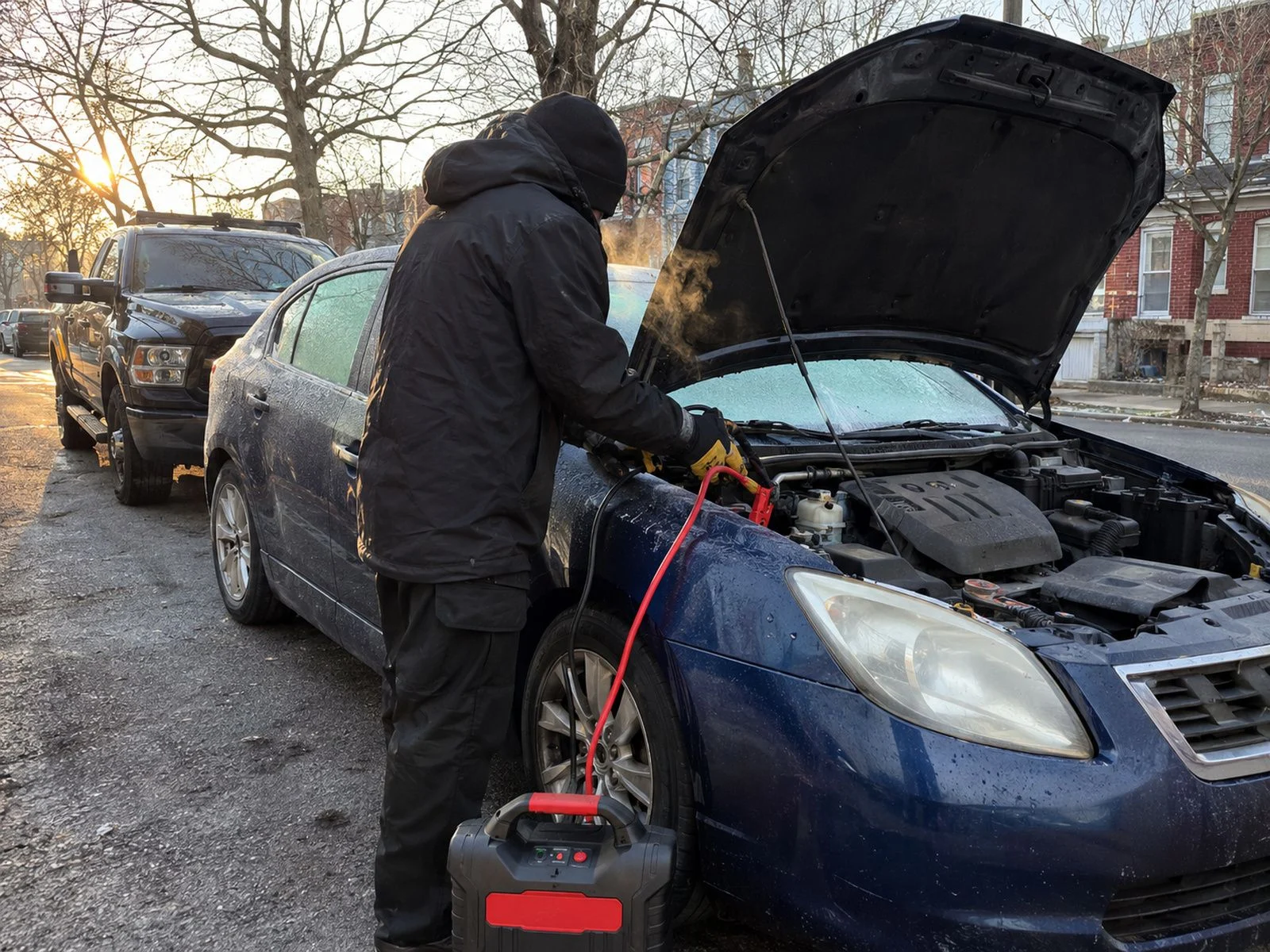
It’s 6:45 on a cold November morning in Fishtown. Your car spent the night on a narrow block off Frankford Avenue, there’s a thin coat of frost on the windshield, and you have somewhere to be. You turn the key and get a fast click-click-click, then nothing. Two cars down, your neighbor’s car starts on the first try, and they give you a sympathetic little wave, which somehow makes it worse.
Short answer: Cold weather slows the chemical reaction inside a car battery, so it gives less power right when a cold engine needs more. If your car clicks or cranks slowly on a cold Philadelphia morning, a weak battery is the most likely cause. A careful jump start usually gets you moving, and then the battery should be tested. If you’re stuck anywhere in Philadelphia, call Tim Speed Towing & Recovery at (267) 787-1662. We’re open 24/7.
Why Cold Weather Is Hard on Car Batteries
A car battery doesn’t hold electricity the way a jar holds water. It makes power through a chemical reaction, and that reaction slows down as the temperature drops. So the same battery that started your car without a problem in September has less to give on a frosty November morning.
At the same time, the engine asks for more. Cold engine oil is thicker, so the starter motor has to work harder to turn the engine over. Less power coming out and more power needed is the reason so many batteries give up during the first truly cold week of the year.
City driving makes it harder. A lot of Philadelphia trips are short and slow: a few blocks down Broad Street, across Market Street to work, around the corner to the store. Short, stop-and-go trips don’t give the alternator enough time to recharge the battery, especially with the heater, the rear defroster and the heated seats all running. On top of that, most cars in the city sleep outside on the street, with no garage to keep the cold off. Day after day, the battery runs a little lower until one cold morning it can’t do the job.
Age plays a part too. Summer heat wears a battery down from the inside, and that damage often doesn’t show until winter. A battery that made it through a hot July can quit on the first frosty morning of November.
Warning Signs Before the Battery Quits
Batteries rarely die without some warning. Watch for these signs as the mornings get colder:
- The engine cranks slowly, like it’s tired, before it finally starts.
- You hear clicking when you turn the key or press the start button.
- The dash lights or headlights look dim or flicker while you start the car.
- The battery warning light comes on while you’re driving.
- There’s a white, green or blue crust on the battery terminals.
- You needed a jump start recently and “it’s been fine since.”
- The battery is several years old. Most batteries have a date sticker on top.
If you notice two or more of these, get the battery tested before the next cold snap. Many auto parts stores and repair shops can check it for you.
Is It the Battery or Something Else?
Not every no-start is a battery problem. This table helps you make a good guess before you call.
| What you notice | Likely cause | What to do |
|---|---|---|
| Fast clicking, dim dash lights | Weak or dead battery | Jump start, then get the battery tested |
| One loud click, lights stay bright | Starter or a loose connection | Stop trying; the car may need a tow |
| Engine cranks normally but won’t start | Fuel or ignition problem | Check the gas gauge; fuel delivery if it’s empty |
| No lights and no sound at all | Fully dead battery or a loose cable | Jump start and check the cables |
| Starts after a jump, then dies while driving | Charging system, often the alternator | Pull over safely and have it towed to a shop |
| Dash says the key isn’t detected | Weak key fob battery | Try the backup start method in your owner’s manual |
How to Jump Start a Car Safely in the Cold
If you have jumper cables and a friend with a running car, here’s the safe way to do it. Check your owner’s manual first, because some cars have special jump points under the hood instead of using the battery directly.
- Park the good car close, but don’t let the two cars touch. Turn both cars off.
- Look at the dead battery. If the case is cracked, bulging or leaking, or it looks frozen, stop. Don’t jump it.
- Clip one red cable end to the dead battery’s positive (+) terminal.
- Clip the other red end to the good battery’s positive (+) terminal.
- Clip one black cable end to the good battery’s negative (-) terminal.
- Clip the last black end to a bare, unpainted metal part of the dead car’s engine, away from the battery.
- Start the good car and let it run for a few minutes.
- Try to start the dead car. If it starts, take the cables off in the reverse order.
- Drive for a good while, ideally on a longer road, not a two-minute loop around the block.
If the car still won’t start after a couple of tries, stop. Cranking over and over can overheat the starter, and the problem might not be the battery at all.
When to Skip the Jump and Call for Help
Sometimes the safe move is not to jump the car at all. Call for help instead when:
- The battery looks frozen, cracked or swollen, or it’s leaking.
- You smell rotten eggs near the battery.
- The car died on the shoulder of I-95, the Schuylkill Expressway (I-76) or the Vine Street Expressway (I-676), where standing next to it isn’t safe.
- The car starts after a jump but dies again a few minutes later.
- You don’t have cables, or there’s nobody around to give you a jump.
In those cases, our jump start service can come to you. If the car needs a shop, we can take it there with light-duty towing. You can see everything we fix on the spot on our Roadside Assistance page.
Garages, Narrow Streets and Highways
Where your car dies changes what you should do next. Philadelphia gives you plenty of choices.
In a parking garage. Center City and University City garages are a common spot for dead batteries, since cars sit there all day in the cold. Tell us the garage, the level and the height limit when you call, so we bring the right equipment.
On a narrow rowhouse street. In Society Hill, Queen Village or the side streets of South Philadelphia, there may be no room for another car to pull up nose to nose. Don’t try to squeeze a second car in and block the street. A jump pack doesn’t need a second car at all.
On a highway. If the car stops in a travel lane on I-95, the Schuylkill or Roosevelt Boulevard, turn on your hazard lights, stay buckled in and call 911 first. Once you’re safe, call us for the tow.
How to Keep Your Battery Healthy This Winter
A little care in November saves a lot of trouble in January:
- Test it early. Have the battery checked before the first deep freeze, not after it dies.
- Clean the terminals. Crusty terminals block power. A shop can clean them, or you can with a battery brush.
- Park in a garage when you can. Even an unheated garage keeps the battery warmer than the curb.
- Take a longer drive once a week. A run on I-95 or the Schuylkill gives the alternator time to top the battery off.
- Turn things off before you shut the car down. Lights, the heater fan, heated seats and the radio all pull power on the next start.
- Use a battery maintainer if a car sits for weeks at a time, like a second car parked on the block.
- Watch the age. If the battery is getting older and already slow, replacing it before winter beats a no-start on a work morning.
What to Keep in Your Car Until Spring
A dead battery in a warm garage is annoying. A dead battery on a cold road at night is a lot worse. Keep these in the car from now until spring:
- Jumper cables or a charged jump pack
- A phone charger that works in the car, plus a small power bank
- An ice scraper and a small shovel
- A blanket, gloves and a hat
- A flashlight with fresh batteries
- Water and a few snacks
- A bag of sand or cat litter for traction
PennDOT has more cold-weather advice on its winter driving page, and you can check road conditions before you leave on 511PA.
What to Tell Us When You Call
When you call (267) 787-1662, these details help us find you and bring the right equipment:
- Where you are: the street and the nearest cross street, or the exit number and direction if you’re on I-95 or the Schuylkill.
- What the car does: fast clicking, slow cranking or nothing at all.
- The car: make, model and color.
- Your situation: on the street, in a garage or lot, or on a shoulder, and whether you feel safe where you are.
- Anything else going on: a flat tire, an empty tank or keys locked inside. It happens more than people admit, especially after leaving the car running to warm up.
We handle those too, with tire change, fuel delivery and car lockout service.
In Fishtown and Across Philadelphia
In Fishtown and Kensington, most cars sleep on the street, so cold mornings hit hard. We get calls from blocks off Frankford Avenue and Girard Avenue and from drivers who stall near the I-95 ramps. Our Fishtown and Kensington towing page has more about that area.
The rest of the city is no different. We help drivers in Center City, Old City, Rittenhouse, Society Hill and Northern Liberties, in University City and across West Philadelphia, in South Philadelphia and up Roosevelt Boulevard in Northeast Philadelphia. Wherever the battery quits, the steps are the same: get somewhere safe, give us a call and we’ll take it from there.
Call Tim Speed Towing & Recovery
A dead battery on a cold morning is no fun, but it’s usually a quick fix. If your car won’t start anywhere in Philadelphia, call Tim Speed Towing & Recovery at (267) 787-1662. We’re open 24/7 for jump starts, towing and Roadside Assistance. You can also read more about us or send a request on our contact page.
Frequently Asked Questions
Can a car battery die from cold weather alone?
Cold weather rarely kills a healthy, fully charged battery. What it does is expose a battery that was already weak, old or undercharged. That’s why so many batteries seem to die “out of nowhere” on the first cold morning of the season.
How long should I drive after a jump start?
Give it a good long drive, not just a few minutes around the block. Short trips don’t put much charge back in. If the car won’t start again the next morning, the battery or the charging system needs a check.
Is it safe to jump start a car in the snow or rain?
It can be, if you’re careful. Keep the cable clamps dry and off the ground, and never let them touch each other. Never jump a battery that looks frozen, cracked or swollen. If you’re not sure, call (267) 787-1662 and we’ll do it for you.
Can you jump start a car in a Center City parking garage?
Usually yes. Tell us the garage, the level and the height limit when you call. Our jump packs don’t need a second car, which helps in tight garages and on narrow streets. See our jump start page for more.
What if my car still won’t start after a jump?
Then the problem may be the starter, the alternator or something else besides the battery. Stop trying so you don’t overheat the starter. We can tow the car to your mechanic with light-duty towing.